a slow, sad solo piano piece in a minor key, sparse and close, with long pauses between phrasesExample
Drums
Bass
Guitar
Keys
Other
Say what kind of sad: grief, missing someone, or the good kind at the end of a story. Each is a different tempo, a different instrument and a different amount of space.
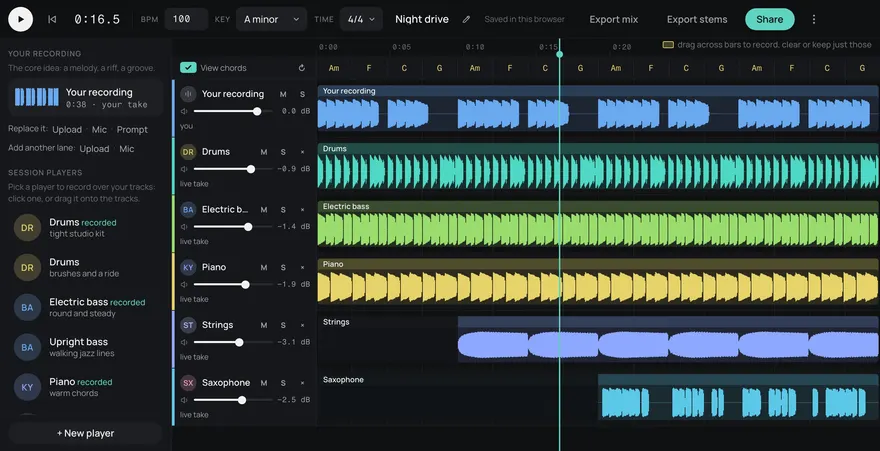
This is an example. Describe your own above and it comes like this too: solo a part, redo one, download them, or edit it in Studio.
Made from these words on this page, each with its stems. Move a level, or press M or S, to hear a part on its own.
Sad covers a lot of ground, and the description lands closer when it says which part.
Sad music under a scene works when it says less than the picture does. Ask for sparse, quiet and close, and for no big build unless the moment has one. If someone speaks, say that the melody should stay out of the way, or that there should be none at all.
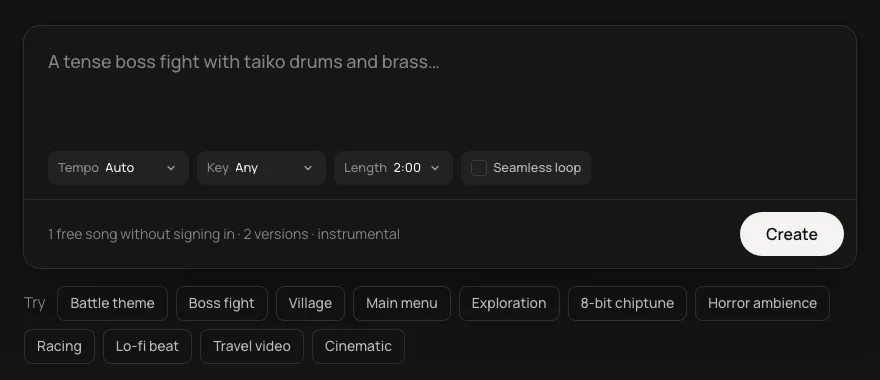
Set a slow tempo yourself if Auto comes back too quick: somewhere from 60 to 75 BPM suits most of these. Match the length to the scene with the Length control, up to two minutes, so the piece ends when the moment does.
Every track is made as five parts, so you can thin it after it's made. Start a scene on the keys alone and bring the strings in on the line that matters. Drop everything but a held pad under dialogue. If a version feels like too much, take a part away before you make another.
Yes. Tracks are royalty-free, so you can use one in a tribute, a slideshow or a film, shared privately or published. Ask for a length that matches your video.
It probably has too many instruments, or a build. Ask for one instrument, say sparse and restrained, and add no swell and no drums. A slower tempo helps as well.
Use fewer instruments and leave more silence. One piano or one cello, a slow tempo and the word sparse does more than a full orchestra swelling. Ask for restraint in the description: quiet, close, no big build.
Yes. Every song is royalty-free on every plan, Free included: use it in commercial games, videos, streams, podcasts and apps.
Yes. Add https://gen.daydream.live/mcp to Claude or ChatGPT (or the Daydream app in ChatGPT) and describe a song in the chat: it plays there with its stems. How to add it.
Updated