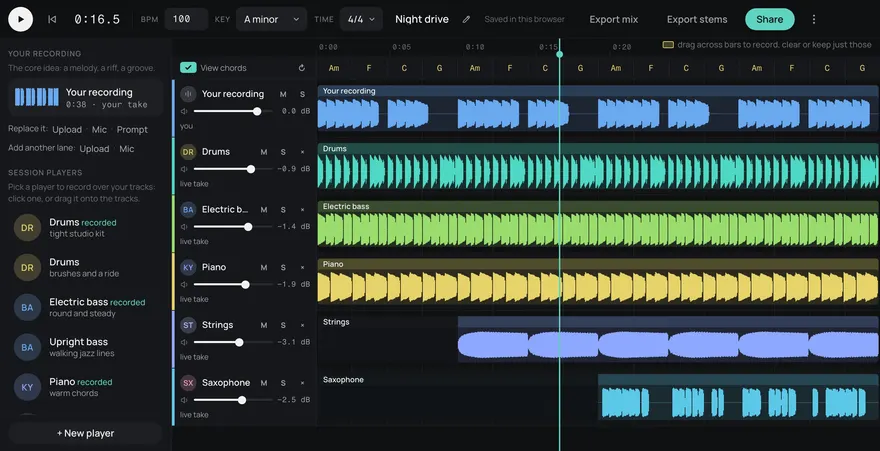
Drums
Bass
Guitar
Keys
Other
Run, jump, fall, try again. Make bouncy level loops for every world that keep the rhythm going through a hundred retries, plus the jingles that close each stage.
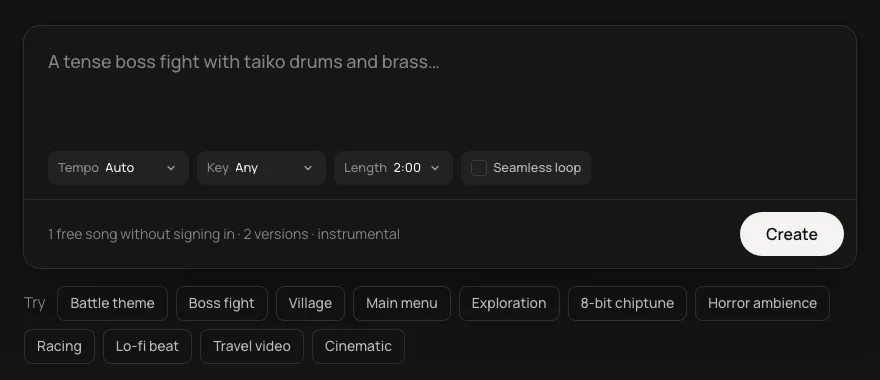
This is an example. Describe your own above and it comes like this too: solo a part, redo one, download them, or edit it in Studio.
Made from these words on this page, each with its stems. Move a level, or press M or S, to hear a part on its own.
A platformer is about rhythm: run, jump, land, again. Music with a clear, steady beat makes the jumps easier to time and the level more fun to repeat. Ask for a bouncy bass, snappy drums and a bright lead, and set a brisk tempo by hand.
Players die and retry the same stretch many times. Turn on Seamless loop and keep the music running through a respawn rather than restarting it, so the tenth attempt doesn't hear the same first bar ten times.
Platformers come in worlds, and each world wants its own colour while still sounding like one game.
Keep one tempo and key across a world's stages, and let the instruments do the changing. For a retro sound, see the 8-bit music generator.
Every track comes as five stems (drums, bass, guitar, keys and other). That gives you level variants without new themes: drop to keys and bass for an underground section, then bring everything back outside. For a hurry-up when time runs low, make a faster track in the same key and switch on a bar line. Close each stage with a short stage clear jingle, loop off, in that key.
Yes, but keep it in the world's family: the same instruments, heavier and in a minor key. A whole new style for the boss can feel like a different game.
Load the level theme as stems and add a layer, or switch to a faster version in the same key for as long as the power-up lasts, then switch back on a bar line.
Brisk enough to push the player forward, and steady, so jumps fall into a rhythm. Set it by hand and keep it the same across a world so each stage feels like part of a set.
Yes. Every song is royalty-free on every plan, Free included: use it in commercial games, videos, streams, podcasts and apps.
Yes. Add https://gen.daydream.live/mcp as a custom connector in Claude, or as a custom MCP server in ChatGPT, or add the Daydream app from ChatGPT's directory, and sign in with your Daydream account. Then describe a song in the chat: it plays there with its stems in their own lanes, and if you ask for new drums it makes that part again with the other four as they are. It spends the same credits as this page, 5 a song. How to add it.