Drums
Bass
Guitar
Keys
Other
Underscore that holds an interview without telling the viewer what to feel. Describe the story and the scene, and build a score from a few related cues.
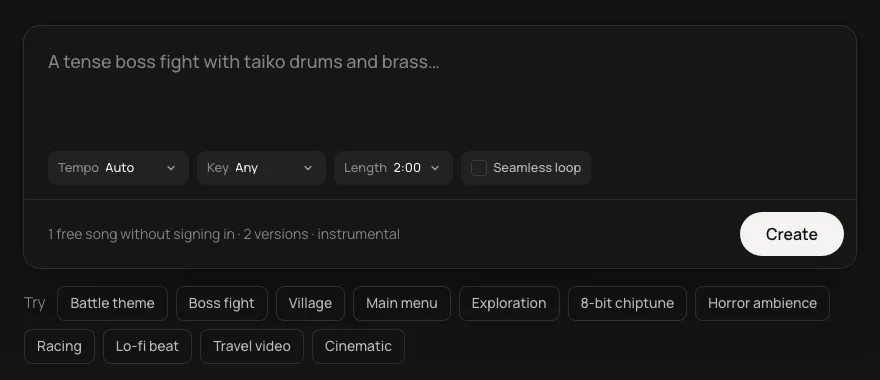
This is an example. Describe your own above and it comes like this too: solo a part, redo one, download them, or edit it in Studio.
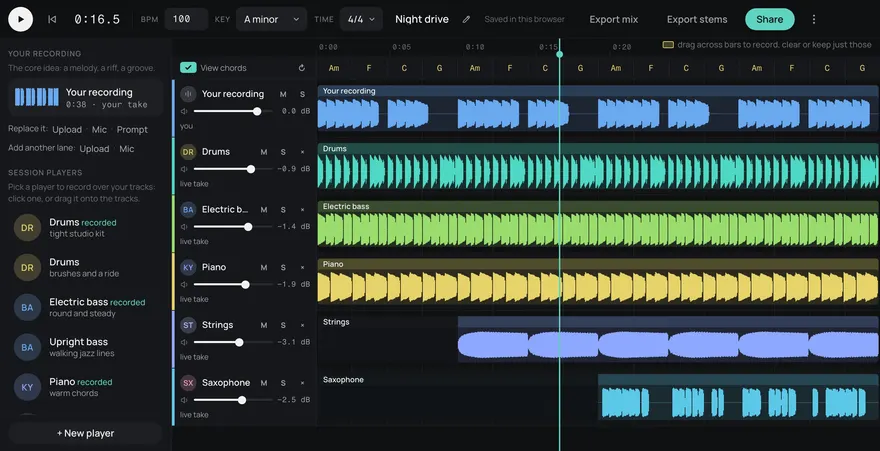
Made from these words on this page, each with its stems. Move a level, or press M or S, to hear a part on its own.
Documentary music sits under real people telling real stories, so it has to support them without pushing a feeling on the viewer. Ask for restraint: "a slow pulse", "long, quiet chords", "no melody that resolves". Soft piano, cello, low pads and gentle percussion suit most interviews. Leave the big strings for the moments that have earned them.
A documentary is scored in cues: short pieces for a scene or a turn, each with its own job. Plan them from your edit:
Keep one key and the same core instruments across them, and the film gets a score of its own rather than a playlist.
Every cue comes as five stems (drums, bass, guitar, keys and other). Under a hard answer, mute everything but a held note in the keys or other, then bring the rest in after the line lands. Make one stem again if it's wrong for the scene and keep the others. For bigger, film-trailer scores, see the cinematic music generator.
Bring it in after an emotional line, not before it, so the person speaks first and the music answers. Keep the harmony unresolved and the melody sparse, and drop the music out completely for the hardest moments.
Each cue is up to two minutes, and a loop can run longer under an interview. A feature takes many cues: plan them as a list from your edit, all in related keys and with the same core instruments.
Less than you'd think. Many scenes play better with none. Use music to carry a transition, hold a silence after a hard line, or move through a montage, and let interviews breathe.
Yes. Every song is royalty-free on every plan, Free included: use it in commercial games, videos, streams, podcasts and apps.
Yes. Add https://gen.daydream.live/mcp to Claude or ChatGPT (or the Daydream app in ChatGPT) and describe a song in the chat: it plays there with its stems. How to add it.
Updated