Drums
Bass
Guitar
Keys
Other
Stone corridors, torchlight and something further down. Make dungeon loops that hold the tension for a whole floor without wearing the player out.
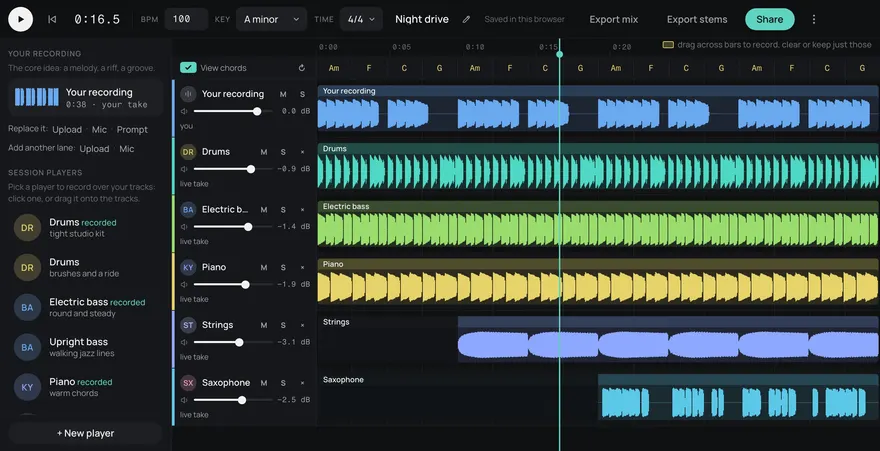
This is an example. Describe your own above and it comes like this too: solo a part, redo one, download them, or edit it in Studio.
Made from these words on this page, each with its stems. Move a level, or press M or S, to hear a part on its own.
A dungeon floor can take twenty minutes, and the music runs the whole time. Loud, busy music exhausts players long before the boss. What works is a steady unease: something low that never quite resolves, a slow pulse, and a melody that turns up now and then.
Dungeon music isn't horror music. Players are meant to feel careful, not scared. For dread, see horror game music.
Every track comes as five stems (drums, bass, guitar, keys and other). Load them as layers and one dungeon loop can follow the player from room to room.
If the drums are too heavy for a crypt, make that stem again with a lighter description and the rest stays as it was.
Give each dungeon its own key and a signature sound (bells for the temple, deep toms for the caverns). For lower floors, make a slower, darker track in that key and the descent becomes something the player hears. For roguelikes, where floors come in a random order, keep the tempo and key the same across the run so any floor can follow any other.
Add layers as the player gets closer: the bass a few rooms out, the drums at the last corridor. Then cut to silence at the door before the boss theme starts.
Give it a short cue with Seamless loop off, in the dungeon's key, so it plays over the loop and lets the drone carry on underneath.
Give each dungeon one key and one sound, then make a darker or slower track in that key for the deeper floors. The player feels the descent and still knows which dungeon they're in.
Yes. Every song is royalty-free on every plan, Free included: use it in commercial games, videos, streams, podcasts and apps.
Yes. Add https://gen.daydream.live/mcp as a custom connector in Claude, or as a custom MCP server in ChatGPT, or add the Daydream app from ChatGPT's directory, and sign in with your Daydream account. Then describe a song in the chat: it plays there with its stems in their own lanes, and if you ask for new drums it makes that part again with the other four as they are. It spends the same credits as this page, 5 a song. How to add it.