Drums
Bass
Guitar
Keys
Other
Set the tempo to the workout, describe the energy, and get a track your viewers can move to while you count them through it.
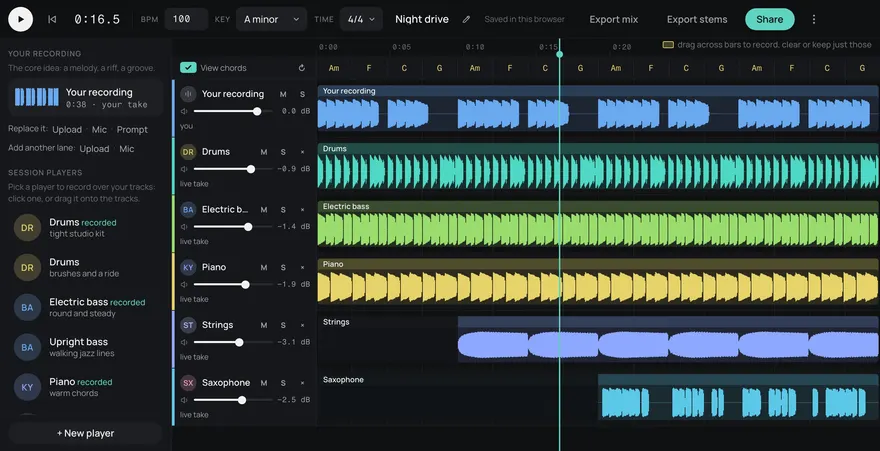
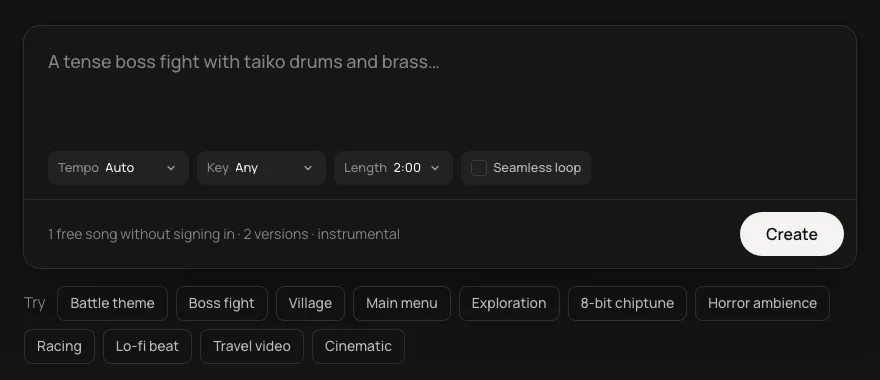
This is an example. Describe your own above and it comes like this too: solo a part, redo one, download them, or edit it in Studio.
Made from these words on this page, each with its stems. Move a level, or press M or S, to hear a part on its own.
In a workout video, viewers move to the beat whether you ask them to or not, so pick the tempo first and the style second. Set the BPM yourself rather than leaving it on Auto:
Intervals are easy to score with one tempo for the whole video. Make a hard track for work and a softer one for rest, both at the same BPM and key, and cut between them on the timer. Seamless loop turns either into a block of any length, so a 40 second round and a 20 second rest come from the same two tracks. Ask for "no big breakdowns" so the energy doesn't drop mid-set.
Counting reps and calling moves means talking over loud music. Every track comes as five stems (drums, bass, guitar, keys and other). Keep drums and bass for the pulse and mute the busier parts while you cue, then let the full mix run during the hardest set. Playing the music to a live class in a room is a different use from a video: read daydream.live/terms before you do.
Ask for it: "driving all the way through", "no breakdowns". Then loop the track, or make several at the same BPM and key and change only the sound, so the energy stays and the music doesn't get stale.
Make one track per block: warm-up, main set, cool-down, each at its own tempo and in the same key. Each is up to two minutes, so loop the long blocks.
Roughly: 60 to 90 BPM for yoga and stretching, 95 to 120 for strength and warm-ups, 125 to 140 for HIIT and cardio. Set the BPM yourself so every move lands on the beat.
Yes. Every song is royalty-free on every plan, Free included: use it in commercial games, videos, streams, podcasts and apps.
Yes. Add https://gen.daydream.live/mcp to Claude or ChatGPT (or the Daydream app in ChatGPT) and describe a song in the chat: it plays there with its stems. How to add it.
Updated